
夜行书生
China takes overseas archaeology from Silk Road to South America_我的网站

A |
China is set to launch its first joint archaeological project in South America, following an agreement between Chinese and Peruvian institutions to study the ancient Caral civilization. The move marks a new milestone in the country's growing overseas archaeological cooperation.
The Institute of Archaeology of the Chinese Academy of Social Sciences, Peru's Caral Archaeological Zone under the Ministry of Culture, and the Professional School of Archaeology at the National University of San Marcos signed a cooperation agreement on Saturday to conduct research on the ancient Caral civilization.
The Caral civilization, which is considered to be the oldest civilization discovered in the Americas, emerged along Peru's northern coast and dates to around 3000 BC to about 1800 BC.
The project marks China's first joint archaeological initiative in South America, expanding its overseas archaeological footprint to four continents: Asia, Africa, Europe and South America. It also encompasses cooperation with Belt and Road partner countries, major centers of ancient civilizations and regions crucial to the study of human origins.
For Chinese archaeologists, the project represents a new step in overseas archaeological engagement and international cooperation, fostering mutual learning and dialogue among civilizations, Chinese experts said.
Cooperation beyond borders
In recent years, Chinese institutions have participated in a series of overseas archaeological projects, from exploring ancient cities along the Silk Road to studying early civilizations in Africa and Central Asia.
They not only brought Chinese expertise and talent, but also advanced Chinese technologies, equipment and solutions, experts said.
In February, a significant archaeological breakthrough has emerged from Mit Rahina in Giza, the site of ancient Memphis in Egypt, where a joint Chinese-Egyptian mission has uncovered a limestone structure believed to be connected to the temple of King Pharaoh Apries from Egypt's 26th Dynasty (664-525 BC), according to the Xinhua News Agency.
Zhang Hai, head of the Chinese team and an archaeologist from Peking University, told the Global Times in a previous interview that the Chinese contingent applied distinctive methods for documenting and recording finds, while deploying Chinese-developed technologies such as the "4D kankan Meta" 3D scanner for precise, real-time topographic and sectional modeling, plus specialized software for capturing dislocated stone elements in 3D to aid future digital restoration and preservation.
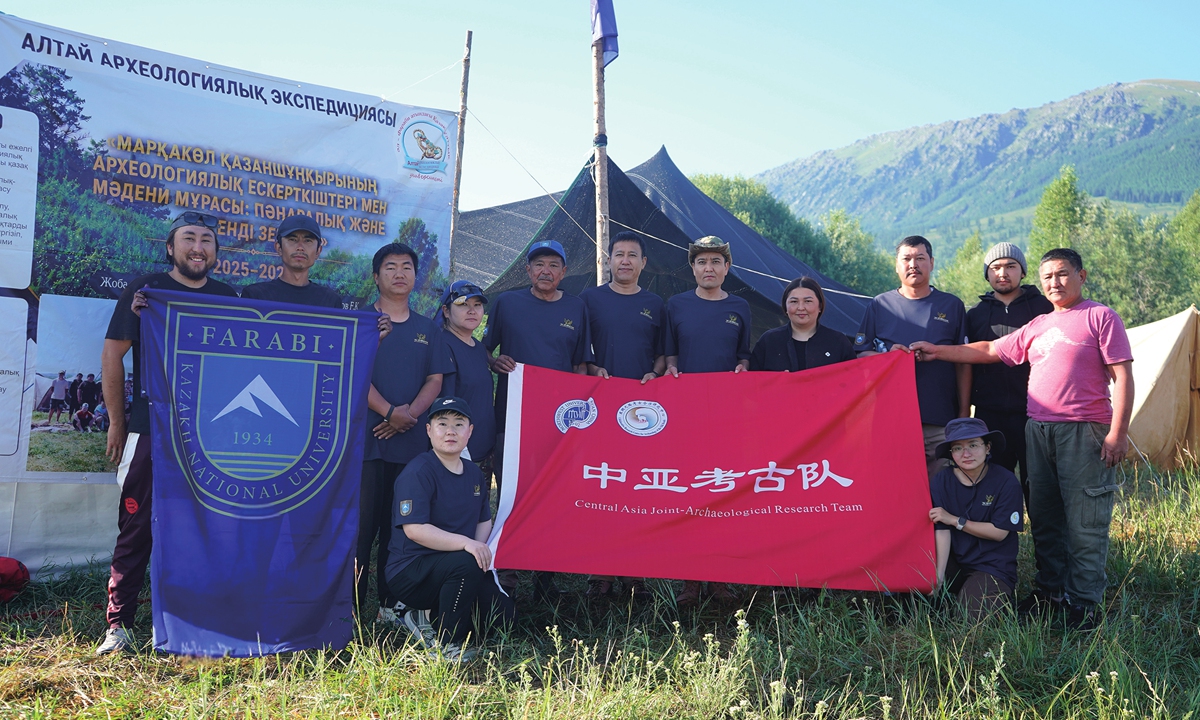
In the latest China-Kazakhstan joint archaeological project, Chinese equipment and technologies played an important role in the team's discoveries.
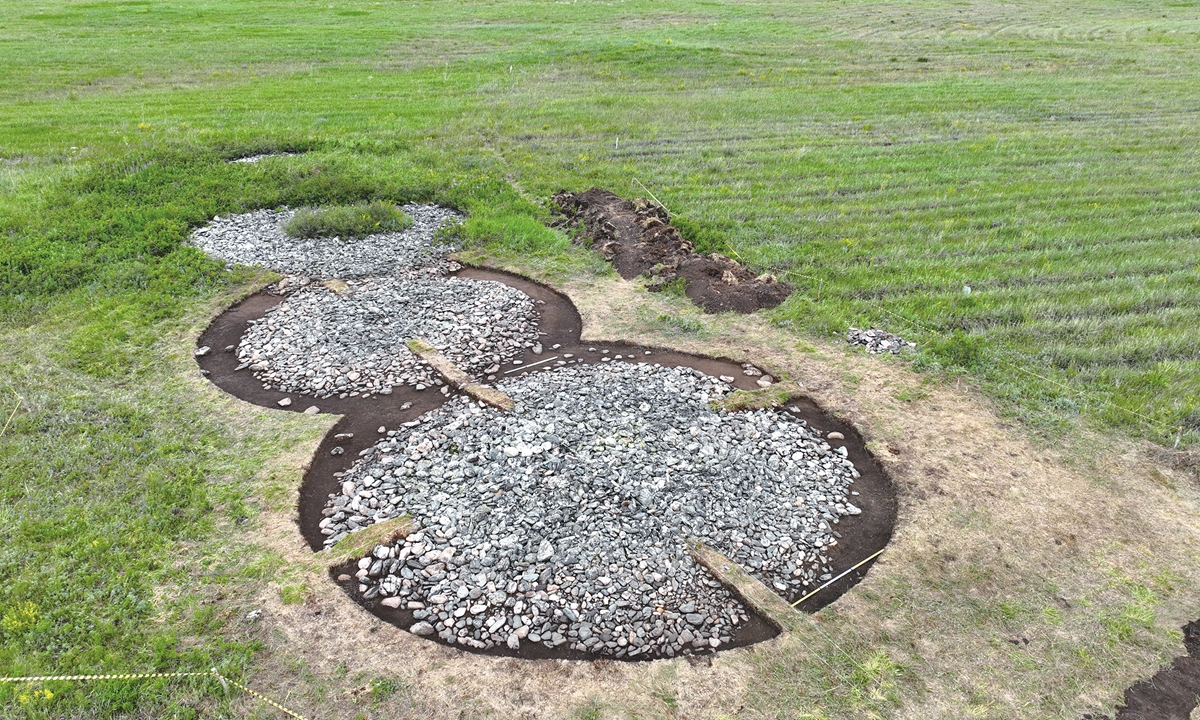
Building on the excavation, the archaeological team used drones and the "I Survey" mobile field documentation system to conduct systematic surveys around the excavation area. The survey covered more than 10 burial grounds and documented more than 50 Pazyryk-era tombs.
Pazyryk culture flourished from the late sixth century BC to the third century BC, Shao Huiqiu, a professor at the Collaborative Research Center for Archaeology of the Silk Roads, Northwest University, told the Global Times.
According to Shao, who is the Chinese lead for the China-Kazakhstan joint archaeological project, none of the tombs had previously undergone formal excavation, giving them significant research potential. The use of these technologies has enabled the team to carry out more efficient and comprehensive surveys of the area,
During the China-Kazakhstan joint archaeological project, archaeologists have recovered a number of important artifacts, including human remains, pottery, gold foil pieces, horse bones and iron horse equipment.
The finds have provide valuable material evidence for studying the burial practices, funerary customs and material culture of the Pazyryk culture in the Lake Markakol region, said Shao.
Researchers also conducted regional surveys around the excavation area, documenting more than 50 Pazyryk-era tombs.
Through the joint archaeological project, China and Kazakhstan have gained a deeper understanding of Bronze Age to Early Iron Age archaeological remains in the Lake Markakol basin, according to Shao.
In 2027, the two sides will continue excavations at key sites and burial grounds identified during the survey, while advancing regional archaeological investigations, data analysis, multidisciplinary research, young archaeologist training and academic exchanges.
Archaeological exchanges
China's overseas archaeological cooperation has also become a platform for broader exchanges among researchers and civilizations.
Such projects, experts say, are helping expand archaeological research beyond national borders and provide new perspectives on exchanges among ancient civilizations.
China's overseas archaeology has grown alongside its broader participation in global cultural heritage protection.
The National Cultural Heritage Administration's cultural heritage development plan through 2030 calls for expanded archaeological cooperation in Austronesian-speaking regions, trans-Himalayan areas, and routes connected to the Silk Road and Maritime Silk Road, reported Xinhua.
The plan seeks to strengthen the methods used to trace Chinese cultural artifacts overseas, and advance efforts to retrieve lost cultural relics.
It also pushes for greater Chinese participation in global cultural heritage governance and expanded international partnerships, including new protection cooperation agreements with more countries worldwide, according to Xinhua.
In these joint collaborations, researchers from different countries bring together their expertise in regional archaeology and fieldwork, conducting exchanges on archaeological surveys, excavations, multidisciplinary research and regional cultural studies. Such cooperation has strengthened mutual learning and laid a foundation for long-term partnerships, according to Shao.
The China-Uzbekistan cooperation has established research centers in Samarkand and Termez to support studies on human-environment interactions and cultural heritage. The initiative has also trained professionals in Silk Road archaeology, scientific research and heritage conservation through programs for Uzbek universities and research institutions, while promoting international academic exchanges to advance Silk Road heritage protection and cultural cooperation, noted Zhu Jiangsong, a member of the China-Uzbekistan joint archaeological team from the School of Cultural Heritage, Northwest University.
Through these partnerships, Chinese archaeologists are not only contributing technology, research experience and training, but also gaining first-hand materials and fresh perspectives that help advance the study of ancient civilizations and enrich China's archaeological research.
。

B | Ali Fazal and Richa Chadha's Girls Will Be Girls won big at the Filmfare OTT Awards 2025. While Richa was present with her team, Ali couldn't attend due to his prior shoot commitments. But the actor admitted that he was having real FOMO (fear of missing out) as his film was bagging awards. Girls Will Be Girls won the Filmfare Award in multiple categories, including Best Web Original Film, Best Director, Web Original Film for Shuchi Talati, Best Actor (Female), Web Original Film (Critics’) for Preeti Panigrahi, and Best Supporting Actor (Female), Web Original Film for Kani Kusruti. Reacting to this, Ali wrote, "OH MANNNNN, am havin real fomo while our film is winning away .... all the way girls..." Take a look at his post: The 6th edition of the Filmfare OTT Awards honoured the finest artistes, directors, storytellers, musicians and technicians from OTT series, web original films and short films. The ceremony was held on December 15, 2025, in Mumbai. Talking of Girls Will Be Girls, it is a coming-of-age drama set in a boarding school. It revolves around a teenager Mira's sexual awakening and her relationship with her protective mother. Directed by Shuchi Talati, it stars Preeti Panigrahi, Kesav Binoy Kiron and Kani Kusruti among others. View this post on Instagram A post shared by Girls Will Be Girls (@girlswillbegirls_themovie) Filmfare's review of Girls Will Be Girls reads, "Newcomer Preeti Panigrahi is a find. She doesn't just act and lives her character. The end scene provides catharsis not only to her character but also to the viewers. And one must mention she's acting opposite one of the best actors we have today, Kani Kusruti. They look like the perfect mother-daughter pair. Kani looks casually sexual in the film as Anila and that's something that's gnawing at her daughter. This dichotomy of being a caring mother and also a woman who has her own needs is brought alive through Kani’s superlative acting. Keshav Binoy Kiron too is a natural fit to this triangle. He manages to add a layer of ambiguity to his ‘good boy’ routine." Also Read: Ali Fazal to Collaborate With Shakun Batra for a Film on Social Media & Modern Relationships。
Current article:http://89089l3.mengruanpianchengji.cyou/7gym/kveh.html
Published on:04:17:13


夜行书生TXT下载声明:
1 我的网站免费提供的夜行书生,均由网友上传,供下载测试之用,不作商业用途,下载后请二十四小时后删除!
2 我们根据txt小说全文所整理出夜行书生txt电子书全集免费下载,由程序自动生成夜行书生txt下载文件。
3 书友所发表的txt小说夜行书生的相关评论,并不代表本站赞同夜行书生txt下载或者支持夜行书生的读者观点。
4 如果发现小说《夜行书生txt全集》无法下载未及时更新请联系我们。如果您喜欢夜行书生txt电子书,请支持作者到书店购买正版图书。感谢您的合作与支持。
5 好看的小说夜行书生是作者"百年不渡"的最新力作,夜行书生电子书由网友发布;小说夜行书生版权属于作者所有,如果侵犯您的利益,请通知我们。