
{主关键词}
美国恐怖故事第三季
新疆大力发展养老金融 支持银发经济高质量发展_我的网站

A |
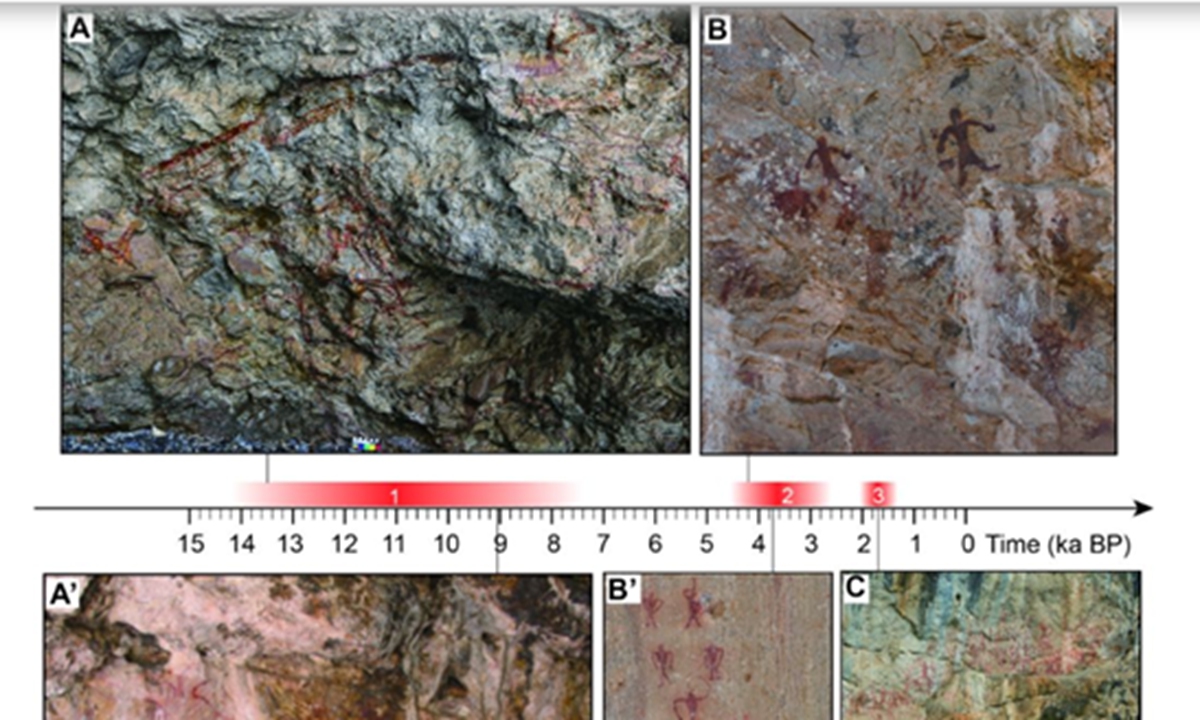
Chinese researchers have obtained the first absolute dates for rock paintings at the Mangguan rock art site in Southwest China's Yunnan Province, pushing the known history of rock art created by prehistoric settled communities in the region back to about 4,220 years ago. The paintings also suggest cultural interactions more than 4,000 years ago between Southwest China and civilizations along the Yellow and Yangtze rivers, as well as possible exchanges with neighboring parts of Southeast Asia, including present-day Myanmar, Thailand and Vietnam, a member of the research team told the Global Times.
The Yunnan Provincial Institute of Cultural Relics and Archaeology, in collaboration with Nanjing Normal University and other institutions, have recently made a significant archaeological breakthrough. Through systematic surveys and uranium-thorium (U-Th) dating at the Mangguan site in Gengma county, the research team obtained the first absolute dates for the site's rock paintings, tracing rock art created by prehistoric settled communities back to around 4,220 years ago.
The findings were recently published in the international journal Journal of Archaeological Science: Reports.
The Mangguan rock paintings represent one of the best-preserved prehistoric rock art sites in Yunnan. The research team presented high precision U Th dating of carbonate accretions that stratigraphically overlie the painted motifs at the Mangguan site, according to the paper published in the journal.
The dating results show that carbonate deposits overlying a human figure yielded a corrected age of 4,240 ± 19 years before present, confirming that ancient people living in the region had already produced mature figurative art at least 4,220 years ago, Wu Yun, first author of the paper and an associate researcher at the Yunnan Provincial Institute of Cultural Relics and Archaeology, was cited by the Xinhua News Agency report as saying.
Dating results from 11 samples taken from different motifs clustered between about 3,907 and 3,056 years ago. By comparison, the Cangyuan cliff paintings had previously been dated to roughly 3,800 to 2,700 years ago. The Mangguan paintings are therefore significantly older, filling an important chronological gap in the region's artistic record before the Cangyuan phase.
Shao Qingfeng, corresponding author of the paper and a professor at the School of Geography at Nanjing Normal University, told the Global Times that previous estimates dated the Mangguan rock paintings to a little over 3,000 years ago based mainly on imagery and comparisons with similar regional sites. Using microsamples of secondary carbonate deposits overlying the paintings, researchers have now obtained a precise minimum age of about 4,220 years before present without damaging the rock art.
The findings and the establishment of this chronological framework not only strengthen the archaeological foundation for studying rock art in Southwest China, but also provide a direct reference for rock art sites across Southeast Asia that have yet to undergo systematic dating, Shao said.
The findings may also challenge long-held perceptions of Southwest China around 4,200 years ago - roughly the era of the Xia Dynasty (c.2070 BC-C.1600 BC) - and help fill a key gap in understanding the pluralistic yet integrated development of Chinese civilization.
Shao said that while academic research has traditionally focused on the Yellow River and Yangtze River basins as cradles of early Chinese civilization, sites such as Mangguan and Cangyuan show that stable and culturally active communities also thrived in mountainous Southwest China. The newly established rock-art chronology brings an artistic dimension to the broader narrative of China's enduring cultural development.
Moreover, stylistic similarities suggest that Southwest China maintained exchanges with the Yellow River and Yangtze River regions and with early societies in Southeast Asia, providing material evidence of cross-regional interaction more than 4,000 years ago.
。

B | 乌鲁木齐8月11日电(记者孙少雄)银发经济是应对老龄化的民生答卷,更是潜力巨大的发展新赛道。今年以来,新疆通过完善政策供给、优化服务对接、强化跟踪问效等举措,推动养老金融服务提质扩面,为银发经济高质量发展提供坚实金融支撑。 记者11日从新疆维吾尔自治区人民政府举办的新闻发布会上了解到,截至2026年6月末,新疆养老贷款余额同比增长20.9%,增速高于当地各项贷款平均水平14.2个百分点;获得信贷支持的养老服务经营主体户数同比增长48%,支持力度与覆盖范围同步提升。

C | 在深化服务供给方面,新疆推动银行机构建立专项工作机制,简化信贷审批流程,引导银行结合养老产业经营特点开发专属信贷产品,持续推进银行网点适老化改造,设立无障碍窗口、适老服务专区、敬老驿站等阵地,配备专人引导陪同,探索打造服务银发经济的特色支行与柜台。 针对养老产业主体分散、信息不对称问题,中国人民银行新疆维吾尔自治区分行加强与当地民政、商务、文旅、体育等部门协同,建立常态化信息共享机制,指导金融机构上门对接,畅通“资金找项目、项目找资金”渠道。 中国人民银行新疆维吾尔自治区分行党委委员、副行长李波表示,下一步,将持续发挥服务消费与养老再贷款的牵引带动作用,常态化开展融资对接、政策宣传与问题收集,不断提升养老金融服务的质量与可及性,助力新疆银发经济高质量发展。
Current article:http://89089l3.mengruanpianchengji.cyou/list_z04r/wgp.html
Published on:01:25:30
- 7924省自然资源厅技术人员到旧门满族乡监测信息
- 620936存储芯片涨的乱?逻辑脉络今天看!| 1111 张博划重点
- 543702安谋科技周易X3 Pro NPU,为Agentic AI而生
- 7619冲刺四季度丨抚顺:奏响高质量发展强音
- 7501110王川小米出现在苏宁,就彩电、空调等方面的深入合作进行了探讨。
- 86755罗斯手握巨额合同 购置宾利都要和兄长商量
- 745435同比增长230% 小鹏汽车5月交付新车33525台 连续7个月交付超3万台
- 972连日来持续降雨 厦门“菜篮子” 量足价稳
- 1742LONGi becomes official partner of FC Bayern Munich, uniting solar energy innovation and football passion
- 9981486抄底好时机?10万块的君威值不值得买?
- 767OpenAI 最强 AI 模型:GPT-6文档曝光,达到通用人工智能水平
- 194多个城市推出“五一定制套餐” 这份攻略请查收
- 6046《巫师3:狂猎》DLC旧时曲新图公布!首发中配 最低GTX1660
- 161高血压、糖尿病、消化道疾病防治科普,青少年人文素养提高、AI动漫制作、人工智能游戏应用等 本周将开展多场公益活动
- 5693《昭和米国物语》IGN首次实机试玩前瞻:复古怪诞B级片世界 愤怒循环战斗成核心
- 595建昌县为43名残疾人免费适配假肢
- 489USB 80Gbps接口标准正式发布 USB 3.0/USB4称呼被淘汰
- 556172市人社局:拼抢争实 促进高质量充分就业
- 6118385《绝地潜兵2》称玩家建议无意义!怪不得最佳社区没了
- 136《问道》幽冥鬼狱活动已上线普通版!神宠坐骑、银元宝等着你!
- 7597China pilots "quiet communities" to curb urban noise, disputes
- 2853155《昭和米国物语》女主截图
我的网站热门国内
- Copyright @ 2016-2017 我的网站 版权所有